History of LED (Light Emitting Diode)#
LEDs are used everywhere in the world today — for lighting, displays, and signaling.
Let’s take a look at how the LED was born, refined, and developed.
1907 — “Wait… it just glowed. What was that?”#
1907, in a laboratory in England.
Henry Joseph Round, a radio communication engineer, noticed a strange phenomenon when he passed an electric current through a silicon carbide (SiC) crystal.
“Whoa! It’s giving off light at the contact point!”
Round reported the phenomenon in the journal Electrical World.
But at the time, no one imagined that this faint glow would one day replace the lighting of the world.
The light was simply too weak to seem useful.
And so the seed of the LED was quietly buried.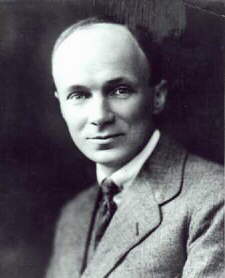
1927 — The Tragic Engineer Who Studied LEDs#
Oleg Vladimirovich Losev, a Russian radio communication engineer, took the study of semiconductor light-emitting devices much further.
At that time it was widely believed that light came from heat, but Losev was the first to prove that the light from semiconductor light-emitting devices was not caused by heat.
He recorded the relationship between voltage and light quantitatively, and laid out the concept of a semiconductor light-emitting device in his papers.
He even predicted that this light could one day be used for illumination and signaling.
But his papers never reached a wide audience.
There was no semiconductor theory yet, Russian papers rarely made it to the West, and he was not a famous scholar.
With the impact of World War II, he tragically passed away in 1942, and his research was cut short.
And so the second seed of the LED was buried.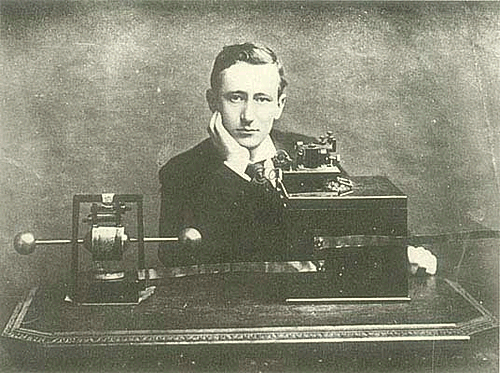
1962 — “Who says semiconductors are only for computing? Let’s make light too.”#
Nick Holonyak Jr., working at the General Electric semiconductor research lab, developed a semiconductor light-emitting device using a gallium arsenide phosphide (GaAsP) alloy.
On October 9, 1962, he demonstrated his device emitting red light by passing current through it, and revealed it to the world.
A few years later it was commercialized — the first generation of the LED.
The light output was not bright enough for general illumination, but it began to be used in limited applications such as indicator lights and numeric displays.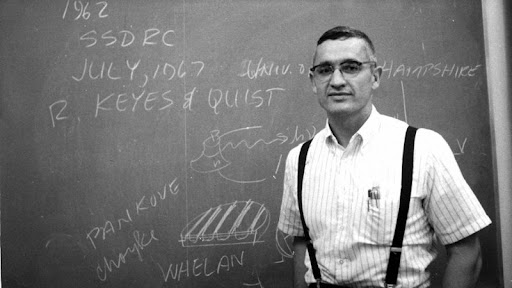
The 1970s–80s — “Let’s develop other colors of LED! But…”#
LEDs continued to be researched and developed into products.
During this era, yellow LEDs and green LEDs were added to the lineup.
Thanks to this, LEDs gradually came into use in traffic signals, instrument panels, and electronic billboards.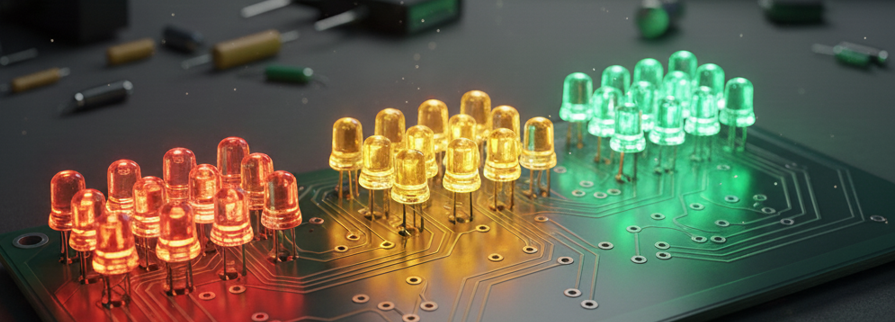
But there was one crucial color that no one could create.
That color was blue.
For LEDs to be widely adopted as general lighting, a blue LED was essential.
Because only with blue light could a color close to natural daylight be produced.
1993 — “Finally, the blue LED is born”#
A research lab in Japan.
Everyone around said the same thing:
“Gallium nitride (GaN)? The crystal won’t grow, and you can’t control the impurities. A blue LED is impossible.”
But Shuji Nakamura kept digging.
Failure, failure, and yet more failure.
And then, one day…
“It lit up!”
At long last, blue light shone.
In 1993, the blue LED was born.
Why was this moment so important?
Because if you coat a blue LED with a phosphor, you get a white LED.
For the first time, humanity had lighting close to natural daylight produced by a semiconductor.
For this discovery, Shuji Nakamura was awarded the Nobel Prize in Physics in 2014.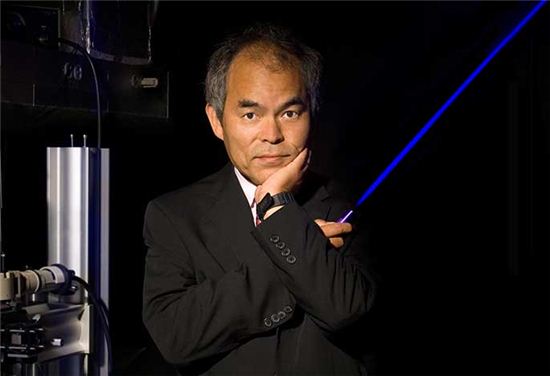
The 2000s — “Pushing Out the Light Bulb”#
A light bulb lasts 1,000 hours; an LED lasts 50,000 hours. The LED’s lifespan is 50 times longer.
A bulb’s efficiency is 15 lumens per watt; an LED’s is 200 lumens per watt. The LED is 13 times more efficient.
Bulbs are easily broken by vibration and shock, but LEDs are highly resistant to both.
In short, LEDs had far more advantages than light bulbs.
And so LEDs spread rapidly.
Homes, offices, factories, streetlights, automobile headlamps — most lighting gradually shifted to LEDs.
As a result, the incandescent light bulb has gradually exited the stage.
A discovery that began as “Huh? It’s flickering at the junction of the material…” now lights our world, displays our information, and grows our food.
The history of the LED is the story of people who kept believing in a tiny, seemingly useless light, all the way to the end.