Communication#
Communication, in simple terms, is about transmitting information.
The concept can be broad and somewhat abstract.
Let’s look at some examples to intuitively understand what communication is all about.
What is communication?#
Case 1: Human Communication#
Humans communicate by making sounds with their mouths and listening with their ears;
this is a form of transmitting information and can be described as communication.
Additionally, humans convey information visually through gestures, body language, and facial expressions.
Most of the various ways in which humans communicate can be characterized as forms of communication.

Case 2: Internet#
If you’re reading this, you’re likely connected to the internet and have accessed the website semonan.com through a web browser.
Not only that, but through the internet, you can do a myriad of things like online shopping, watching YouTube videos, and searching for restaurants.
All of these activities involve exchanging information using the internet, which can be considered a form of communication.

Case 3: Mobile phone#
Modern mobile phones, often called smartphones, can do many things similar to a computer, including voice calls, video calls, and internet browsing.
Since they transmit information, they can be considered a form of communication.
And since they transmit this information wirelessly, without the need for physical connections, we can say they use wireless communication.

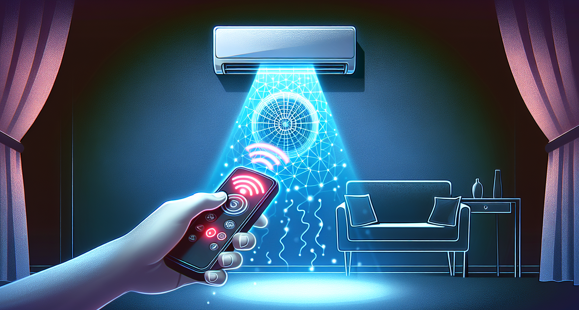
Case 4: Remote Control#
Many household appliances such as TV, air conditioner, and washing machine are controlled via a remote control.
For example, a remote control can send commands to turn the air conditioner on or off and adjust the temperature.
Therefore, this can also be considered a form of communication.
Case 5: GPS#
We can determine location using artificial satellites that orbit the Earth and GPS receivers.
This involves receiving location information from the satellites, which can be considered a form of communication.

There are likely many more examples.
Thus, communication has become an essential element that cannot be absent from human daily life.
Let’s learn about the basic principles and theories of how this important communication transmits information.
I will explain the overall flow of communication from hardware to software.
How do digital devices communicate information?#
Information used in digital devices such as computers, mobile phones, and home appliances is represented by 1 and 0.
The representation of 1 and 0 can involve various methods such as voltage, frequency, light, among others.
Utilizing these methods to transmit 1 and 0 to other devices is the communication of the device.
Let’s look into these methods in detail.
Wired communication#
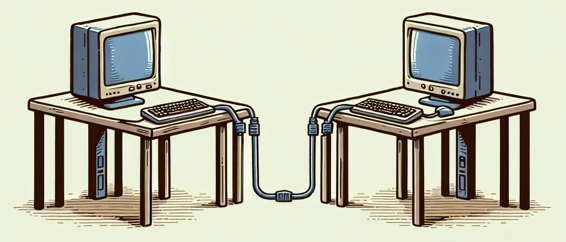
Wired communication involves connecting multiple devices with a wire that carries electric current, and transmitting 1 and 0 through variations in voltage.
This method allows for stable and fast signal transmission, but it requires the physical connection of electrical wires.
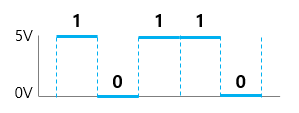
In this context, 1 represents a relatively high voltage, and 0 represents a relatively low voltage.
For example, as shown in the diagram, 5V corresponds to 1, and 0V corresponds to 0.
For communication to occur, there must be a transmitter that sends information and a receiver that accepts it.
Additionally, there has to be an agreement on the method of communication, known as a protocol, so that the received information can be understood.
The following diagram is an example of a simple protocol capable of transmitting 8 bits.
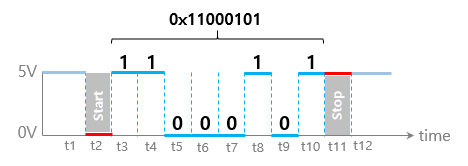
- t1 time: This is a waiting state with no data transmission, maintaining 5V.
- t2 time: The voltage changes from 5V to 0V to indicate the beginning of data transmission. This is called the Start bit.
- t3 to t10 time: The 8-bit data being transmitted. In the diagram provided, it is transmitting 0x11000101.
- t11 time: The 8-bit data transmission concludes, and the voltage returns to 5V. This is referred to as the Stop bit.
- t12 time: Similar to the t1 state, it’s a waiting state with no data transmission, maintaining 5V.
In this way, the transmitter sends 8 bits, and the receiver interprets the received signal according to the protocol to understand that it is 0x11000101.
If you want to transmit 16 bits, you can simply repeat the above protocol twice (8 bits x 2 = 16 bits).
To transmit data more quickly and reliably, various protocols exist.
Wireless communication using radio waves#
Wireless communications such as WiFi, Bluetooth, and 5G transmit signals through radio waves.
Digital wireless communication using radio waves transmits 1 and 0, and this method is more complex than the wired communications previously described.
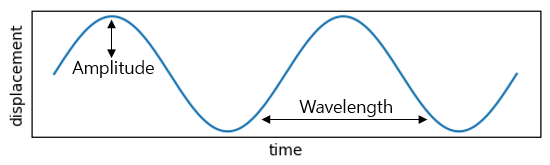
Radio waves can be generated by using alternating current in an antenna to alternate between positive and negative charges.
Furthermore, radio waves are transmitted in the form of waves as shown in the figure above, and are greatly influenced by the external environment.
For example, it is quite difficult for radio waves to propagate in water, and the presence of obstacles such as metal can hinder signal transmission.
For these reasons, wireless communication that utilizes radio waves uses modulation/demodulation techniques to reliably transmit 1 and 0.
There are various types of modulation/demodulation techniques, including Amplitude Modulation, Frequency Modulation, and Phase Modulation, among others.
To simplify, I will explain the easily understandable techniques of Amplitude Modulation and Frequency Modulation.
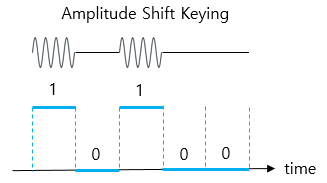
First, a typical modulation/demodulation technique of Amplitude Modulation is known as Amplitude Shift Keying (ASK).
As shown in the following diagram, ASK is recognized as 1 if there is amplitude, and as 0 if there is no amplitude.
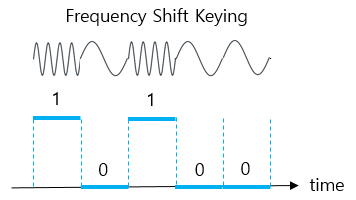
The second is Frequency Shift Keying (FSK), a typical modulation/demodulation technique of Frequency Modulation.
As shown in the following figure, FSK can recognize a high frequency as 1 and a low frequency as 0.
The following figure shows that wireless communication can transmit data, 1 and 0, through a modulation device, and can receive 1 and 0 from radio waves through a demodulation device.

Let’s look at some helpful characteristics of wireless communication:
- The lower the frequency, the further it can transmit and the better it can penetrate walls or obstacles.
- The higher the frequency, the more difficult it is to transmit over long distances and to penetrate obstacles.
- The higher the frequency, the larger the bandwidth, which can increase communication speed.
Optical communication#
Optical communication uses light to transmit signals.
For example, the presence of light could represent a 1, and the absence of light a 0.

There are wired communications that utilize optical cables designed to carry light, as well as optical wireless communications that transmit signals without cables, like TV remote controls.
Wired communications based on optical cables are very fast but tend to be expensive, whereas optical wireless communications(infrared communications), being cable-free, are convenient but susceptible to external noise, thus having a shorter communication range.
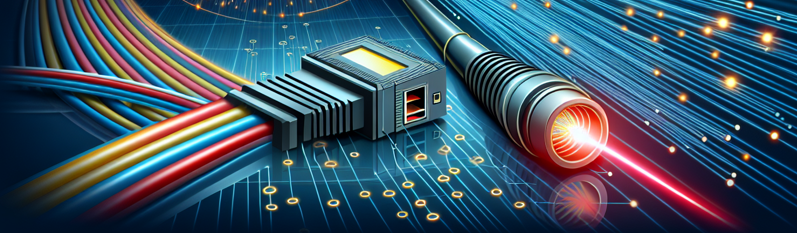
As illustrated in the figure, the transmitter converts electrical signals into optical signals to transmit information, and the receiver converts optical signals back into electrical signals to read the information.
The medium used to transmit the signal is light, which makes it similar to wired communication that uses electrical signals.