Memory Manufacturers Are Raking In Money#
Samsung Electronics, SK Hynix, and Micron are the world’s three largest memory manufacturers. They generate huge operating profits by producing and selling DRAM. As of December 2025, DRAM demand has surged so much that they reportedly cannot keep up with supply. In other words, DRAM makers are raking in money, and this trend is expected to continue for the foreseeable future. What exactly is DRAM, and why has its demand suddenly skyrocketed? Let me explain why.
A Quick Look at DRAM#
For a computer to operate, it needs a processing unit (CPU) and storage devices. Storage devices generally fall into two categories: non-volatile storage like SSDs, and volatile storage like DRAM. Both are used to store data, but their roles inside a computer are quite different.
First, the role of storage like an SSD is to save files, as is commonly known. Even when the computer is powered off, the data is preserved, which is why it is called non-volatile storage.
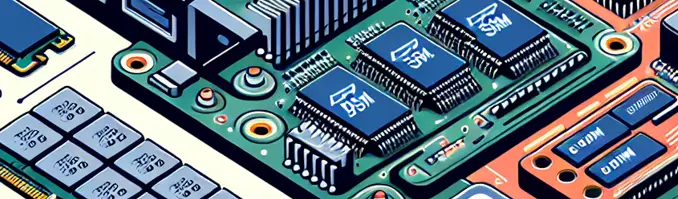
On the other hand, many people are unclear about what DRAM actually does, so let me explain the core concept. What happens when we run a program like a text editor? The contents of the text editor file stored in storage are loaded (copied) into DRAM. Then, the CPU does not process the text editor program from storage; it processes the copy that was loaded into DRAM. In other words, the CPU does not directly process files saved in storage — it loads them into DRAM and accesses DRAM to process them. You can think of most running programs on a computer as being loaded into DRAM.
Why is it processed after being loaded into DRAM? The reason is processing speed. These days, an SSD has a bandwidth of about 7 Gb/s, while DRAM has a bandwidth of about 50 Gb/s — DRAM is much faster. Because storage cannot keep up with the CPU’s fast processing speed, DRAM acts as a buffer between the CPU and storage, easing the storage bottleneck to some extent. This is the fundamental role of DRAM in a computer.
Why Is So Much DRAM Needed?#
If you had to pick the most rapidly advancing technology of the past five years, it would be AI. In particular, starting with ChatGPT in 2022, the AI era based on LLM (Large Language Model) technology has begun. AI is now starting to permeate our daily lives. It is already being used across many fields including documents, design, healthcare, research, coding, and music production.

Such Large Model-based AI is software that requires huge capacity. GPT-4 from ChatGPT is estimated to be over 700 GB. These days, a typical desktop uses about 32–64 GB of DRAM. Such a computer doesn’t have enough DRAM, so it cannot even run a GPT-4 model that exceeds 700 GB. To run software this large, high-capacity DRAM is essential.
In addition, AI processing requires extremely fast computation. Ordinary computers can’t handle it; we use devices called GPUs that are specialized for parallel computation, and they require a lot of DRAM. You need these parallel-computing devices to run AI software smoothly.
Demand for AI continues to grow, and meeting that demand requires a massive number of devices like GPUs. Currently, supply falls far short of demand. For these reasons, GPU demand has exploded, and DRAM demand has surged along with it.
As a side note, high-end GPUs do not use ordinary DRAM — they use a special, high-speed/high-capacity DRAM called HBM. HBM is a product that stacks multiple DRAM dies and packages them into a single chip, providing thousands of IO pins. Nowadays, DRAM is stacked 12 layers or more. In other words, selling one HBM is equivalent to selling 12 legacy DRAMs. However, HBM is difficult to manufacture, so supply still falls short of demand. As a result, it sells at very high prices.
Summary#
- Software is processed after being copied into DRAM.
- LLM-based AI is high-capacity software.
- Since such large-scale AI is also software, it can only run with DRAM.
- Demand for AI usage continues to grow.
- As a result, DRAM demand is also growing.
- DRAM supply falls short of demand.
- Therefore, DRAM prices are rising.